


Most leaders approach a bigger role with one strong instinct: prove themselves quickly.
That instinct is understandable. There are new expectations, new relationships, new meetings, and often much more visibility. Whether you have been promoted internally or have joined a new organization, there is usually some pressure to show people they made the right decision.
So leaders often move quickly, take on a lot, and try to add value wherever they can. They prove themselves through effort and responsiveness, but over time that can create a pattern where too much work, too many decisions, and too many escalations flow through them.
For Directors and VPs stepping into a bigger role, the first 90 days are not only about proving you can do the job. They are about learning the role, building trust, clarifying what success looks like, and setting up how the work will happen going forward.
Done well, the first 90 days can create clarity and momentum. Done poorly, it can mean that the organization to rely on you for too much, too soon.
The pressure to prove yourself
When you step into a bigger role, the pressure comes from many places at once.
Your leader may be watching to see how quickly you get up to speed. Your peers may be trying to understand how you operate. Your team may be wondering what will change. Senior stakeholders may already have expectations, opinions, or concerns. And then, of course, there is the pressure you put on yourself.
Many capable leaders are used to being valued for their reliability, responsiveness, and ability to solve problems. Those strengths often helped them get the bigger role in the first place, so when they arrive, they naturally lean on what has worked before. That may feel useful in the moment, but it can create a pattern that is hard to unwind later.
If every issue comes to you, every decision waits for you, and every gap is filled by you, the role quickly becomes too heavy. You may prove you are capable, but you may also become the centre of too much.
Early mistakes to avoid
One of the most common mistakes leaders make in the first 90 days is doing too much, too quickly.
They want to show momentum, so they start making decisions before they fully understand the context. They rely on what worked in a previous role, only to discover the dynamics are different here. They may solve the visible problem while missing the underlying pattern.
Another common mistake is staying too close to execution.
This happens often when leaders have been promoted because they were strong operators and they know how to get things done, unblock issues and how to step in when something is messy or unclear.
But in a bigger role, the job is not to be the strongest problem-solver in every conversation. The job is to create the conditions for other people to lead well.
That means noticing when you are answering questions your leaders should be learning to answer. It means being careful about attending meetings where your presence may accidentally reduce ownership. It means asking whether your involvement is building capacity or creating dependency.
A third mistake is under-investing in relationships because the work feels urgent.
This may not be urgent, but building relationships is strategic and will help you long term. Your peers, your leader, your team, and your key stakeholders will shape your ability to make progress. If you do not understand what matters to them, where trust already exists, and where there is tension or history, you may move quickly in the wrong direction.
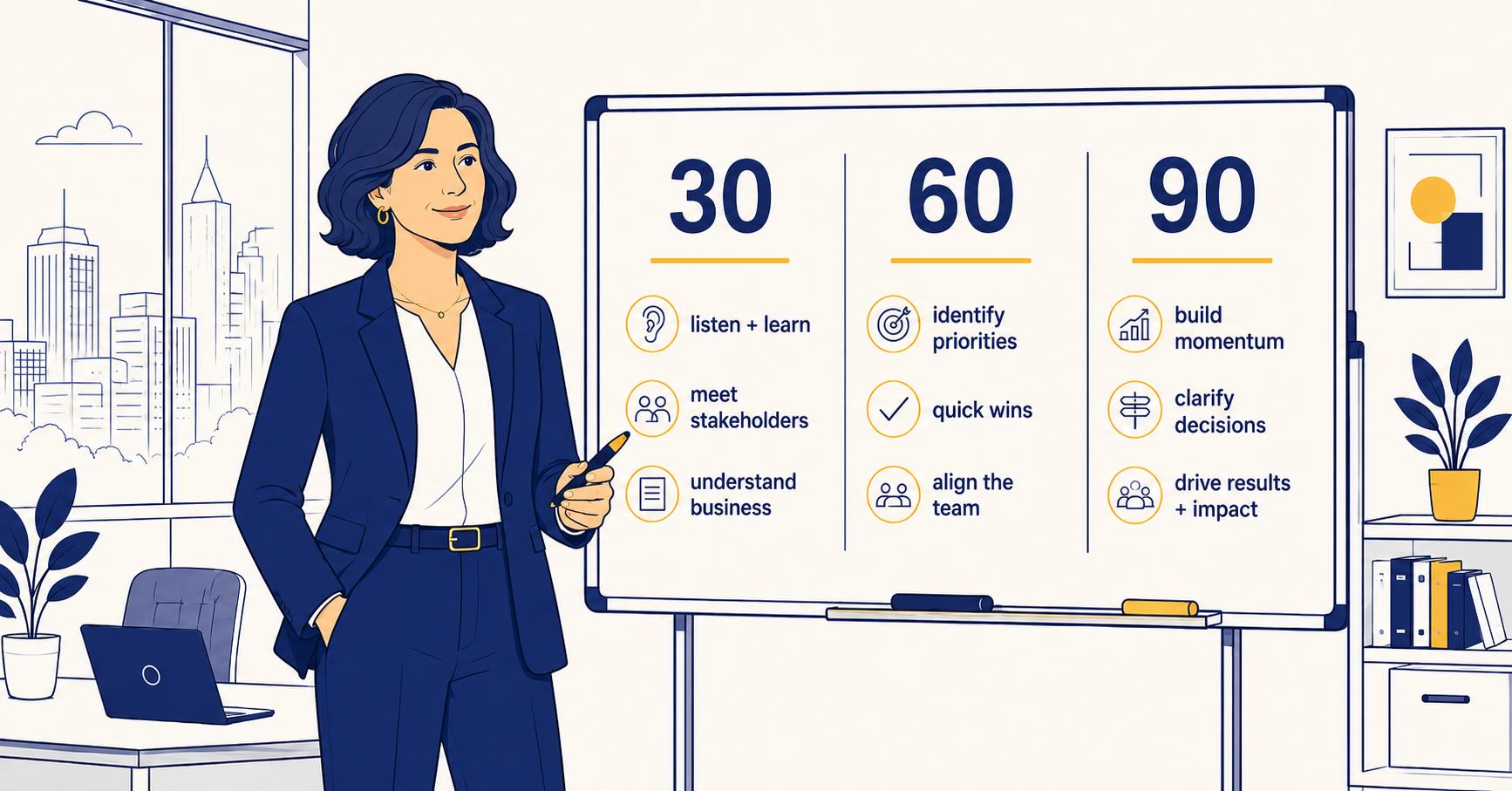
First 30 days: learn before you lead too hard
In the first 30 days, your job is to understand the system you are now leading. This involves lots of listening and curiosity.
When I moved into a new role in a different part of the organization, I was clear with leadership upfront. For the first 30 days, I was not going to come in with recommendations. I was going to meet with team members, key stakeholders, and executives to understand where things stood, what was working, what was not, and where trust needed to be built. After those 30 days, I would come back with clear recommendations.
That approach helped in two ways. First, it gave me a much better understanding of the real issues, not only the ones that were most visible. Second, it showed the team and stakeholders that I was not coming in assuming I had all the answers. I was there to listen, learn, and then lead with more context. That is the goal of the first 30 days should do.
You are trying to understand the role beneath the role. What is the formal mandate? What are the unspoken expectations? Where is the team strong? Where is the team stretched? What has already been tried? Where are decisions getting stuck? Which relationships need attention early?
The org chart gives you the formal structure, but your conversations will help you understand how work, influence, and decisions actually move.
In short, the first 30 days are for understanding the system before changing it.
Days 31–60: clarify the mandate and shape priorities
Once you have listened and observed, the next step is to turn what you are learning into clarity.
In my work with senior leaders, this is often the turning point: moving from understanding the role to deliberately shaping how the role will work.
This is where many leaders need to move from absorbing information to shaping direction. Not everything can be a priority. Not every problem needs to be solved immediately. Not every inherited meeting, process, or expectation needs to stay as is.
Days 31 to 60 are a useful time to clarify the mandate.
What does success really look like in this role? Are you there to stabilize, grow, transform, rebuild trust, improve execution, strengthen the team, or reduce noise? Different mandates require different leadership choices.
This is also the time to begin shaping priorities across people, process, and productivity.
On the people side, look at whether the right leaders have the right ownership. Are decision rights clear? Are there capability gaps that need attention? Are people looking for your to do work that should sit with someone else?
On the process side, look at how work actually moves. Where do decisions slow down? Where are meetings creating clarity, and where are they creating more work? What keeps getting escalated?
On the productivity side, look at where energy and effort are going. Are people focused on the work that matters most, or is the team reacting to everything with the same level of urgency?
This is where you start to move from learning the role to designing how the role will work.
This is the phase where insight turns into action.
Days 61–90: build ownership and step back from execution
By days 61 to 90, your focus should become even more intentional.
You are not only setting direction. You are setting clear expectations for the team on how you will to lead, what they can expect from you and what you expect from each of them.
If you want more accountability, define what that actually means. If you want fewer escalations, clarify the vision, goals and what decisions your leaders can make without you. If you want more strategic thinking, create space for conversations that are not only about updates and issues.
This is also the point where you need to begin stepping back from execution.
That can be difficult, and an area that I have found difficult in the past. It is especially challenge when you can see exactly how you would solve the problem yourself. But every time you step in too quickly, you may be taking away an opportunity for someone else to build confidence, judgment, and accountability.
Stepping back doesn’t mean shirking the work, on not supporting your team. It means being more deliberate about where your involvement adds the most value.
Sometimes that means asking better questions instead of giving the answer. Sometimes it means letting a leader bring forward a recommendation before you share your view. Sometimes it means allowing a meeting to be led without you, even if it would be faster for you to take over.
This does not mean becoming unavailable or stepping away from the team. It means being more intentional about when your involvement is needed and when others need to own the decision. This is how you ensure your role is adding value, while also setting your team up to be successful and learn from you.
By this stage, your job is not only to lead the work, but to shape how leadership happens around you.
Change how you measure early success
Many leaders measure the first 90 days by quick wins, visible output, and how much they personally deliver. Those things can matter. But in a bigger role, they are not enough.
A better measure of early success is whether direction is becoming clearer. Are the right conversations happening earlier? Are relationships getting stronger? Are your leaders beginning to take more ownership? Are decisions moving with less dependence on you? Does your own leader understand your priorities and trust your judgment?
This can feel less immediately satisfying than jumping in and fixing things. It may feel slower. It may be less visible at first. But it is often the work that creates capacity for the months ahead.
Do not ignore quick wins, but do not make them your only measure of success. In a bigger role, clear direction and stronger ownership matter more over time.
Sustainable leadership starts early
The first 90 days are not about having everything solved. They are about being intentional with the patterns you create.
If you make yourself the centre of every decision early on, people will continue to come to you for every decision. If you step in every time something feels messy, your team may learn to wait for you instead of building their own judgment. If you fill every gap yourself, the gaps may stay hidden longer than they should.
Sustainable leadership starts when you set up the role in a way that does not depend on your constant involvement. That means clarifying priorities, building trust, creating better decision paths, and giving your leaders the space to own more of the work while still learning from you.
Use the first 90 days to understand the role, build trust, clarify priorities, and create the conditions for others to take ownership. That is what positions you to lead the role well over time.
So the question is: are you trying to prove yourself, or are you positioning yourself for the role you actually want to lead?
If you are stepping into a Director or VP role, the first 90 days often shape whether you become the centre of too much or create the conditions for stronger ownership around you.
This is the kind of transition I help leaders navigate, so they can lead with more clarity, build trust faster, and set up the role in a way that is sustainable over time.