


There comes a point in many leadership careers where what used to work stops working.
For many, this is the moment they realize that effort alone is not enough and that sustainable leadership for senior leaders requires a different way of operating.
Not because their capability has reduced, but because the role, and expectations, have changed. You’re no longer only responsible for delivering results. You’re expected to shape outcomes, lead other leaders, and operate across a broader system. The work becomes less about execution and more about judgment, prioritization, and influence.
And yet, many leaders respond in the same way they always have. They step in more often, stay close to the work, and take on additional responsibility to keep things moving. For a while, that approach continues to produce results. But over time, it becomes unsustainable, and the way they are operating no longer matches what the role actually requires.
The Pattern I See Often
Leaders stepping into larger roles often describe a similar experience. Their scope has expanded, but their time has not. They are pulled into constant responsiveness, moving from one issue to the next, while the work that requires deeper thinking gets pushed to the edges of their day.
For many leaders, this starts to feel like a pinball game, reacting to whatever comes next instead of creating space to lead more intentionally.
They are still seen as dependable and capable, often the person others rely on to solve problems or make decisions. But that reliability can quietly turn into over-reliance. Instead of creating space for others to step up, they become more central to everything, even when that is not the intent.
What makes this challenging is that, on the surface, things are still working. Deliverables are being met and the team is moving forward. But underneath, there is a growing sense that their time and attention are not aligned with what actually matters most at their level.
The Reframe: From Reactive Leadership to Intentional Leadership
Sustainable leadership is not about slowing down or stepping back from responsibility. It is about being far more deliberate in how you lead and where you choose to focus your attention.
It requires a shift from responding to everything toward deciding what truly matters. It means moving from staying close to execution to shaping direction and creating clarity for others. It also involves letting go of being the default problem-solver so that capability can build within the team.
This is not always an obvious shift, and it is rarely something leaders are given time to work through. Many are expected to figure it out while continuing to deliver at a high level, which is why they often stay in patterns that no longer serve them or the organization.
Why Traditional Leadership Development Falls Short
Most leadership development programs are designed to cover a wide range of skills and competencies. While that can be useful earlier in a career, it often misses the mark at more senior levels.
At this stage, leaders are not looking for more information. They are looking for clarity. They need to understand what success truly looks like in their role now, where their time should be spent, and where it should not. They need practical ways to navigate competing demands without being pulled in every direction.
This is why a more focused approach matters. Instead of trying to improve everything, the work needs to concentrate on the areas that will most significantly change how a leader operates day to day.
What Sustainable Leadership Actually Looks Like
Sustainable leadership is about building a way of operating that allows you to deliver at the level your role demands, increase your impact and visibility, and do so in a way that can be maintained over time.
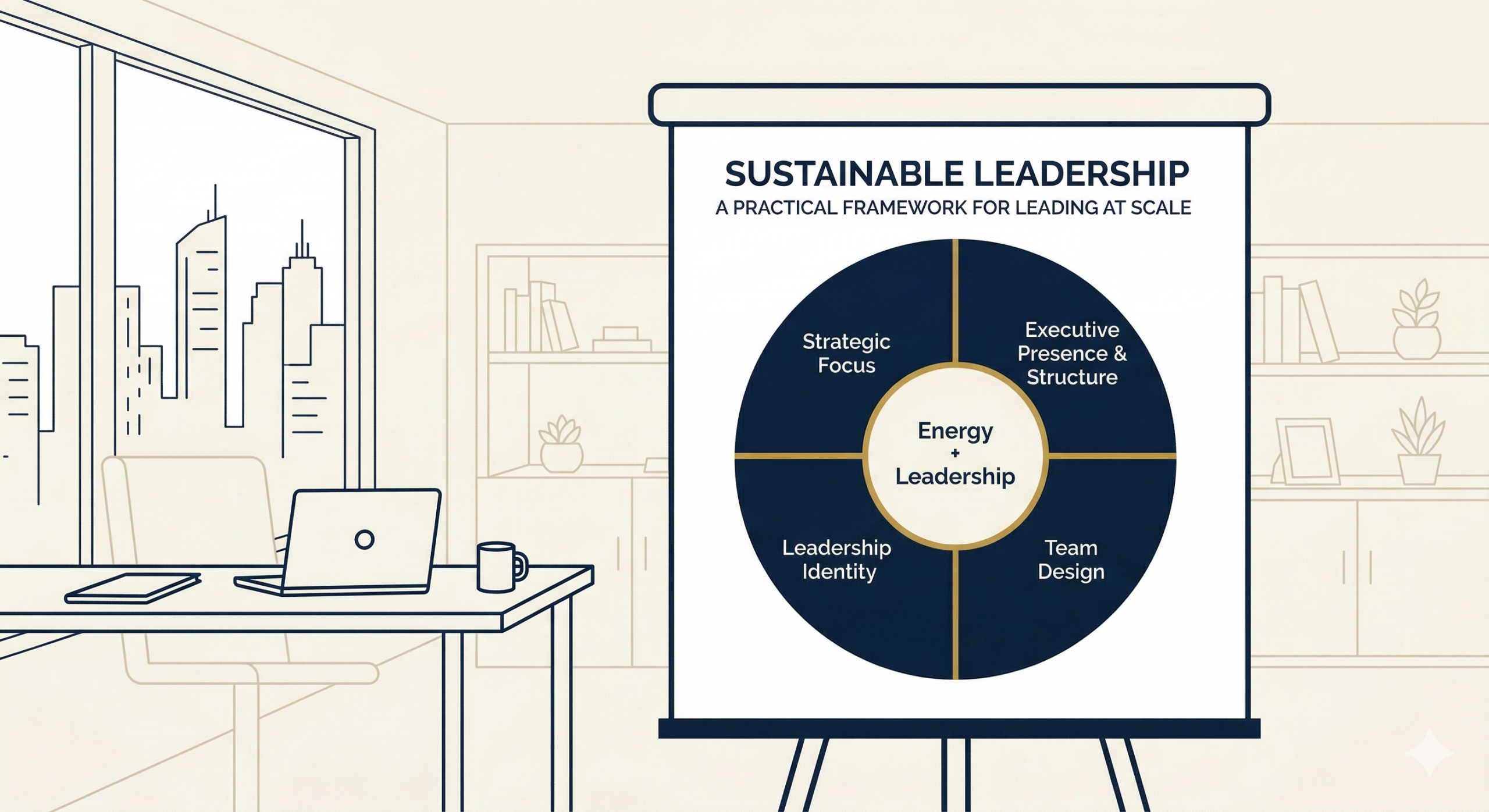
In my work with leaders, this typically comes down to five core areas.
Strategic Focus is about getting clear on what truly defines success at your level and shifting from constant responsiveness to intentional direction. It often starts with a simple but difficult discipline: identifying what truly matters most, and making sure those priorities are not crowded out by everything else competing for your time.
Executive Presence focuses on how you show up in high-stakes conversations. This includes the ability to communicate in a way that connects your work to enterprise-level outcomes, rather than staying at the level of activity or detail. At this level, visibility is less about speaking more and more about helping others clearly see how your thinking supports better decisions.
High-Performance Team Design is about reducing dependency on you by building capability in others and creating clarity in decision ownership. When this is done well, the team operates with greater autonomy and accountability.
Leadership Identity involves defining who you are as a leader at the next level and aligning how you show up with that expectation. This is often the internal shift that enables all of the external changes to take hold.
Energy and Leadership Sustainability underpins all of this work. It is about recognizing that your time, attention, and capacity are finite, and building operating rhythms that allow you to sustain performance over time rather than continually stretching beyond it.
These areas are not theoretical. They show up in very practical ways through how leaders spend their time, how decisions get made, and how their teams function day to day.
Why This Work Matters Now
Leadership today is operating in a different context than even a few years ago. Priorities shift more frequently, expectations continue to expand, and leaders are often asked to deliver results in environments that are still taking shape.
In this environment, continuing to rely on effort and responsiveness alone becomes increasingly difficult to sustain. Leaders can find themselves carrying more than they need to, staying closer to execution than is helpful, and having less space to focus on the work that moves the organization forward.
Sustainable leadership provides a way to reset how you operate within that context. It creates clarity on where to focus, how to lead through others, and how to manage competing demands without being pulled in every direction.
What Leaders Walk Away With
This work is grounded in practical application rather than theory. Leaders leave with a clearer understanding of what matters most in their role and stronger boundaries around how they use their time and attention.
They build teams that operate with greater ownership, reducing the need for constant involvement. They develop a more strategic approach to leadership, allowing them to step back from day-to-day pressure and focus on broader impact.
They also leave with a structured plan they can apply immediately, including a 90-day implementation plan that reflects their priorities and the way they want to operate going forward.
A Final Thought
Most leaders do not need to take on more. What often creates the biggest shift is making more intentional decisions about what they carry, what they let go of, and how they choose to show up at their level.
That is the work of sustainable leadership, and it is what allows leaders to expand their impact without feeling like they have to hold everything together themselves.