


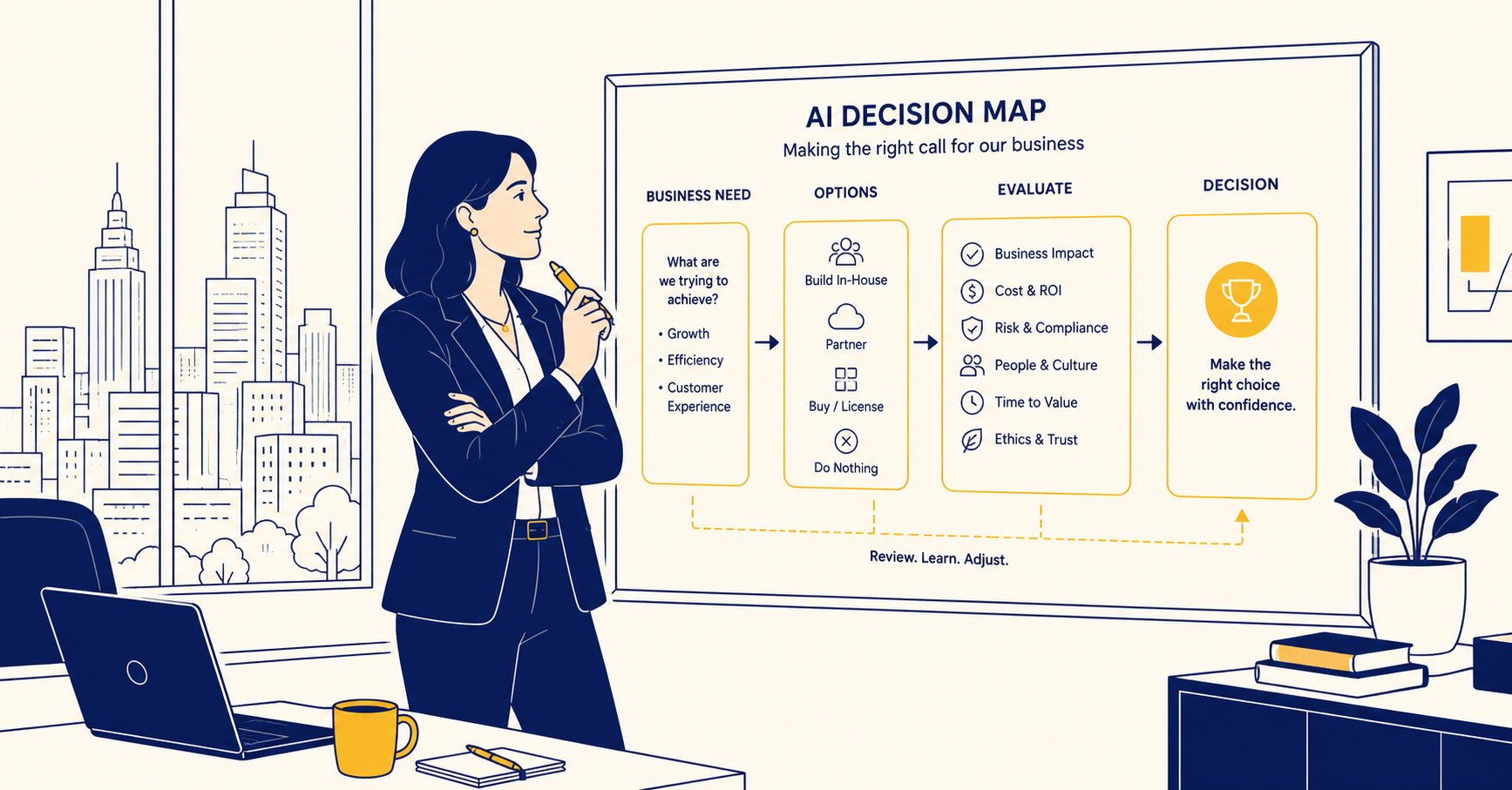
AI is showing up in more conversations than ever. It is in strategy decks, vendor pitches, transformation roadmaps, board updates, and team meetings. For many senior leaders, the pressure is not only to understand AI, but to make decisions about it. That can be difficult when the conversation gets technical quickly.
If you are a VP or senior leader outside of technology, you do not need to become an AI engineer. You do not need to understand every model, architecture, or technical term. But you do need enough understanding to ask better questions, challenge assumptions, and know when the organization may be moving too quickly or not thoughtfully enough.
You can build some of that understanding through formal learning, conversations with technical experts, and governance discussions. You can also build it by using AI yourself in low-risk, practical ways. That kind of personal experimentation helps leaders see both the opportunity and the limitations more clearly.
This matters because AI is not just a technology decision. It is also a business decision, a risk decision, a people decision, and often a client or employee experience decision. When AI is treated as something that belongs only to IT, organizations can miss the broader implications. When business leaders approve AI work without understanding the assumptions behind it, they can create risk they did not intend to create.
Start with the business problem, not the AI tool
One of the most common issues I see with AI conversations is that they start with the tool instead of the problem. Someone sees a demo, hears about a new capability, or feels pressure to do something with AI, and suddenly the organization is looking for a place to use it. I have seen that in the past with other tech tools, but the pressure to use AI is very high across the org.
The better starting point is to ask what problem the organization is trying to solve. Is the goal to reduce manual work? Improve decision quality? Create a better customer experience? Help employees find information faster? Identify risk earlier? Increase consistency? Support growth without adding the same level of cost?
Those are different problems, and they do not all require the same type of solution. There are many facets to AI and it can solve different problems. Some problems may need automation, others require better data or there may need to be a process redesign before AI is even introduced. And of course, some issues may not need AI at all.
A useful question for leaders is: “What decision, task, or experience are we trying to improve, and how will we know if it is better?”
That question brings the conversation back to business value. It also makes it easier to avoid confusing activity with progress.
Build your own fluency by using AI yourself
One of the best ways for senior leaders to build AI fluency is to use it personally.
That does not mean putting confidential information into a public tool or using AI without understanding your organization’s policies. It means finding low-risk ways to experiment so you can better understand what AI can and cannot do.
This is different from many other technologies. Most leaders could not easily experiment with cloud architecture, cybersecurity platforms, enterprise data tools, or automation infrastructure on their own. AI is different because many of the tools are accessible enough that leaders can use them directly. You can try using AI to summarize a non-confidential article, draft questions for a meeting, compare options, pressure-test a message, organize your thinking, or create a first draft of something you will later review and revise.
That personal use matters because it builds practical judgment. You start to see where AI is helpful, where it saves time, where it produces something generic, where it misses context, and where human judgment is still required. You also start to understand why the quality of the prompt matters, why the output needs review, and why AI can feel impressive without always being right.
This is an important distinction for leaders. AI can be useful, but it is not a magic bullet. It will not fix unclear strategy, poor data, weak processes, lack of accountability, or low adoption. In some cases, it may make those issues more visible.
The opportunity for leaders is to become more fluent without pretending to be technical experts. Personal experimentation helps you ask better questions because you have seen the tool in action. It makes the conversation less abstract. It also helps you separate reasonable enthusiasm from unrealistic expectations.
A useful practice is to choose a few low-risk tasks and use AI consistently for a few weeks. Pay attention to where it helps, where it falls short, and what kind of human review is needed. That experience will make you a better sponsor, decision-maker, and challenger when AI shows up in larger business conversations.
Understand where human judgment is still required
AI can help summarize, draft, identify patterns, generate options, and support decisions. But in many business contexts, it should not replace judgment. This is especially true when the work involves people, clients, risk, legal obligations, financial decisions, or reputational impact.
The phrase “human in the loop” gets used often, but leaders need to be specific about what it actually means. Does a human review every output before it is used? Does a human only review exceptions? Who is accountable if the AI output is wrong? What training does the reviewer need? Are they expected to approve, challenge, or simply rubber-stamp what the tool produced?
This is where leadership accountability matters. If a team says there will be human review, that may sound reassuring, but it is not enough. The leader needs to understand how the review works, who owns the decision, and what happens when the tool produces something inaccurate, incomplete, biased, or inappropriate.
A practical question to ask is: “Where does human judgment sit in this process, and who is accountable for the final decision?”
That one question can reveal whether the organization has designed the process carefully or whether it is relying on vague reassurance.
Pay attention to data readiness
AI depends heavily on data. If the data is incomplete, poorly governed, outdated, biased, scattered across systems, or difficult to interpret, the output will reflect that. This is one reason AI projects often expose issues that already existed in the organization.
For non-technical leaders, the question is not whether the data architecture is perfect. The question is whether the data is good enough for the decision or task being supported.
There is a big difference between using AI to summarize public information and using AI to support pricing, hiring, client recommendations, risk assessment, or operational decisions. The higher the impact of the use case, the more carefully leaders need to understand the data behind it.
Useful questions include: “What data is being used?” “Who owns it?” “How current is it?” “What data is excluded?” “What assumptions are being made?” “What are the consequences if the output is wrong?”
These are all important questions as you do your due diligence.
Do not confuse a successful demo with a scalable solution
AI demos can be compelling. A tool can produce an impressive summary, answer a question quickly, or create a polished draft. That can create the impression that the organization is closer to implementation than it actually is.
A demo shows possibility. It does not prove readiness.
To move from a demo to a useful business capability, the organization needs to think about integration, governance, process change, adoption, training, support, measurement, and risk management. The work has to fit into how people actually do their jobs. It has to be maintained. It has to be monitored. People need to know when to trust it, when to challenge it, and when not to use it.
This is where many AI efforts get stuck. The proof of concept looks promising, but the organization has not done the harder work required to make it valuable at scale.
Senior leaders should be asking: “What would need to be true for this to work in the real operating environment, not just in a controlled demo?”
That question helps separate experimentation from implementation.
Know when to bring in Risk, Legal, Privacy, Cyber, and HR
AI is often discussed as an innovation topic, but it can quickly become a risk topic. Depending on the use case, leaders may need input from Risk, Legal, Privacy, Cybersecurity, HR, Finance, Compliance, or other control functions.
This is not about creating unnecessary bureaucracy. It is about involving the right people early enough that the team does not have to unwind work later.
For example, if an AI tool uses employee information, client data, confidential business information, or third-party content, privacy and legal questions may need to be addressed. If it connects to internal systems, cybersecurity matters. If it affects hiring, performance, scheduling, service decisions, or employee experience, HR and legal considerations may be relevant. If it affects financial reporting, pricing, risk models, or regulatory obligations, governance becomes even more important.
A practical leadership question is: “Who needs to be involved before this moves forward, and what decision rights do they have?”
The earlier this is clarified, the less likely the organization is to create confusion, delay, or avoidable risk later. Measure value, not just usage, that is easy to game and will not produce the desired results.
What value is this bringing (not just checking the “Adopt AI” box)
Adoption matters, but usage alone is not the same as value. A team may use an AI tool frequently because it is interesting, easy, or encouraged. That does not mean it is improving outcomes.
Leaders need to define what success looks like. Is the goal faster turnaround time? Better quality? Reduced rework? Improved client experience? More consistent decisions? Lower cost? Greater employee capacity? Better risk detection?
Without clear measures, AI can become another initiative that consumes attention without proving impact.
It is also important to measure unintended consequences. Is the tool creating overconfidence? Are employees relying on outputs without review? Is quality inconsistent? Are certain groups affected differently? Is the process faster but less thoughtful? Are teams using workarounds because the official tool does not meet their needs?
A useful question is: “What will we measure to know whether this is creating business value, and what will we monitor to know whether it is creating risk?”
For non-technical executives, the goal is not to know every technical answer. The goal is to ask the questions that create better decisions.
That means being clear on the business problem. Building enough personal fluency to understand both the opportunity and the limitations. Understanding where human judgment matters. Knowing whether the data is ready. Looking beyond the demo. Bringing in the right partners. Defining value. Paying attention to adoption, risk, and accountability.
AI will continue to change. The tools will get better, the language will evolve, and the pressure to move quickly will not disappear. But strong leadership still requires the same fundamentals: clarity, judgment, accountability, and the ability to bring the right people into the conversation.
You do not need to be the most technical person in the room to lead well through AI. You do need to be willing to learn enough, experiment thoughtfully, and ask the questions that help the organization use it well.