


One of my coaching clients came to me initially to work on executive presence. They were confident and articulate, but they also waned to “show up” as the senior leader they were becoming.
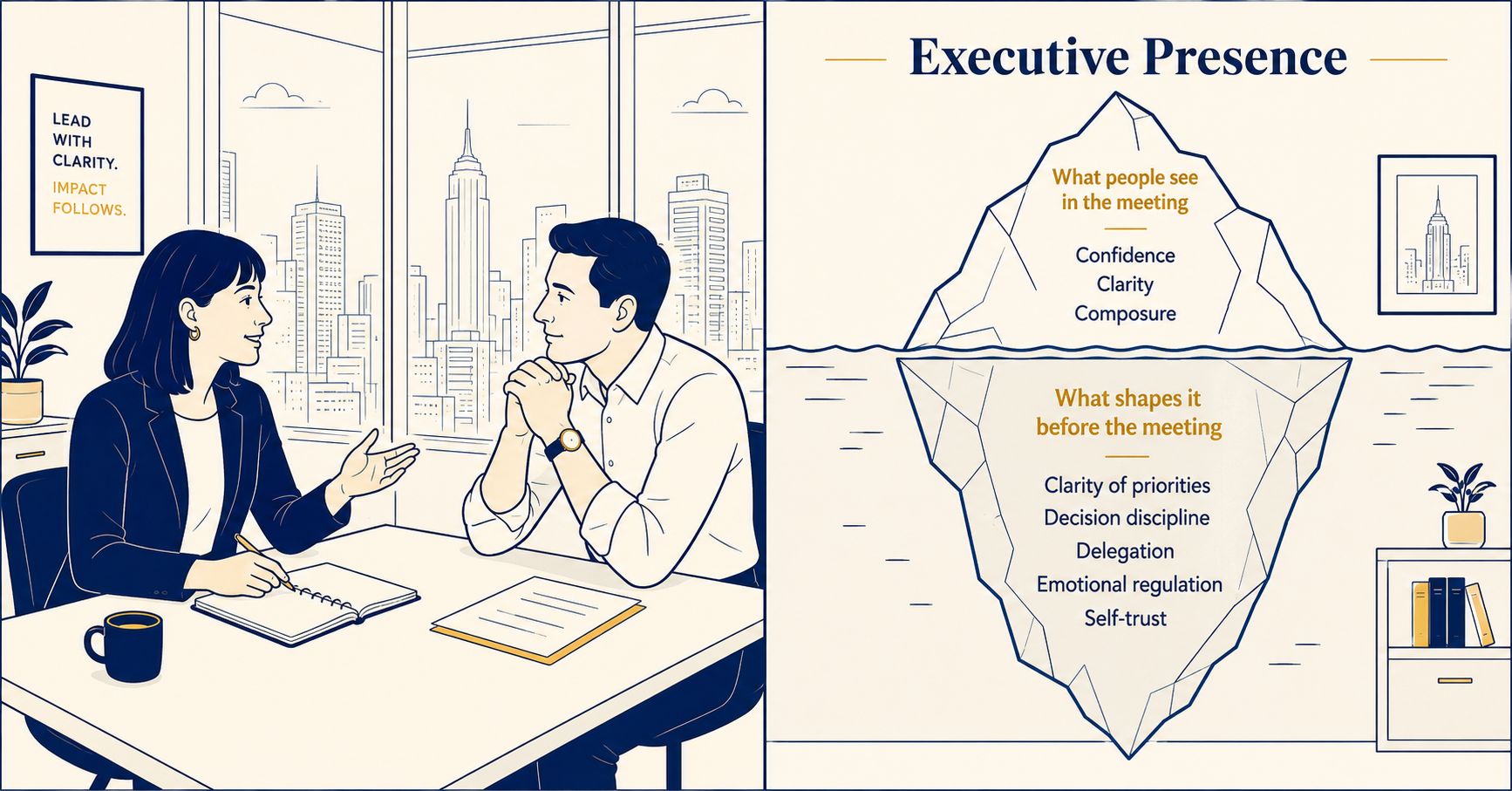
Once we started working together, it became clear that executive presence was not only about what was happening in the executive meetings. It was also about everything that happened before they got there.
How clear they were on their priorities before they walked into the room. How much they were carrying that no longer needed to be theirs. How cleanly they had made decisions before the discussion started. How much pressure they had absorbed before anyone else could see it. How much they trusted their own judgment before they spoke.
That became the focus of the coaching. We started with clarity of priorities. Before coaching, everything felt urgent. There were too many priorities, too many things the team needed decisions on, and too many places where they were trying to stay across it all.
In the first couple of sessions, we spent time sorting through what the real priorities were, what was no longer aligned, and what, although it would be great to do, was distracting from the primary goals and metrics. We also looked at what genuinely needed their attention, what could be deferred, what could be delegated, and what was no longer a priority and could be removed.
After those session they started to walk into meetings with that clarity, they were no longer trying to hold everything at once. They were calmer, sharper, and more intentional.
We also spent time on decision discipline. Before coaching, decisions were taking more energy than they needed to. They were second-guessing themselves, revisiting choices that had already been made, and over-explaining their thinking to the people around them.
In coaching, we worked on creating cleaner decision criteria. What needed their input? What could be decided by others? What information was enough? And when was it time to move forward rather than keep circling back?
The outcome was not that they became faster for the sake of it. They were still thoughtful, but the difference was that they were no longer treating every decision as something that needed to be explained from every angle.
Delegation was another important area. Before coaching, they were holding onto work that no longer needed to be theirs. The intent was to protect the team and not overload them, but the impact was that the team weren’t learning and they could handle more.
In the coaching sessions, we looked at where their involvement was truly adding value and where it was actually slowing the team down. We also worked on how to delegate more clearly, including what setting expectations, giving the team room to bring their expertise to the tasks and seeing there were times that delegation was a learning opportunity.
Again, this impacted how they showed up at the executive meetings, they weren’t running late after doing a final doc review, they weren’t distracted answering a quick ping from the team about that deliverable. They had more space to think, listen, contribute, and lead.
We also worked on emotional regulation. Before coaching, stress and pressure were showing up more visibly than they wanted. Even when they were prepared, they could feel internally busy, and that made it harder to project the calm and steadiness they wanted others to experience.
In coaching, we worked on noticing the moments when pressure started to take over, building in small pauses, and creating ways to reset before reacting. We also worked on separating urgency from intensity, so they could respond to pressure without absorbing all of it.
That was an important part of their executive presence because it affected how they entered the room, how they responded to challenge, and how much steadiness others felt from them.
The final and honestly most important area was self-trust. Before coaching, they were regularly second-guessing themselves or waiting for extra validation before speaking with conviction. Their thinking was correct, but the hesitation lessened their impact.
In coaching, we worked on recognizing the evidence behind their judgment, naming what they already knew, and speaking from a place of clarity rather than trying to prove they belonged in the room.
Over time, they started trusting their judgment more. They were speaking with more clarity, less apology, and more certainty in what they brought.
What has been most encouraging is that the feedback they are getting now is not simply, “you look more confident.”
It is more along the lines of:
“You seem more strategic”, “You’re more composed”, “You carry yourself with more authority”
And that is my point, Executive presence is not just what people see once you are in the meeting. It is often shaped by the work you have done before the meeting.
The priorities you have clarified, the decisions you have made, the work you have entrusted with your team and your judgment that you have learned to trust.
So if executive presence is something you are working on, it may be worth asking a different question. Instead of “How do I show up in the meeting?” try asking “What do I need to sort out before I walk into the room?”