


Many leaders of leaders are being asked to deliver outcomes they do not fully control.
Budgets are uncertain. Hiring decisions are delayed. Purchasing approvals take longer. AI initiatives are under scrutiny before success has even been clearly defined. Yet expectations for delivery remain high.
This is where leadership can become mentally exhausting: you are accountable for progress, but many of the conditions shaping that progress sit outside your authority.
For leaders of leaders, the pressure rarely stays personal. They are also answering questions from the leaders who report to them, deciding where limited capacity should go and trying to protect their teams from absorbing more than they can realistically deliver.
It is understandable for all the possibilities to start swirling in your head: whether funding will be approved, whether a role will eventually be filled, whether an AI initiative will produce the results senior leaders expect or whether another delayed decision will put a critical deadline at risk.
When all of those concerns remain tangled together, it becomes difficult to see which ones require action, which ones can be influenced and which ones are consuming energy without moving anything forward.
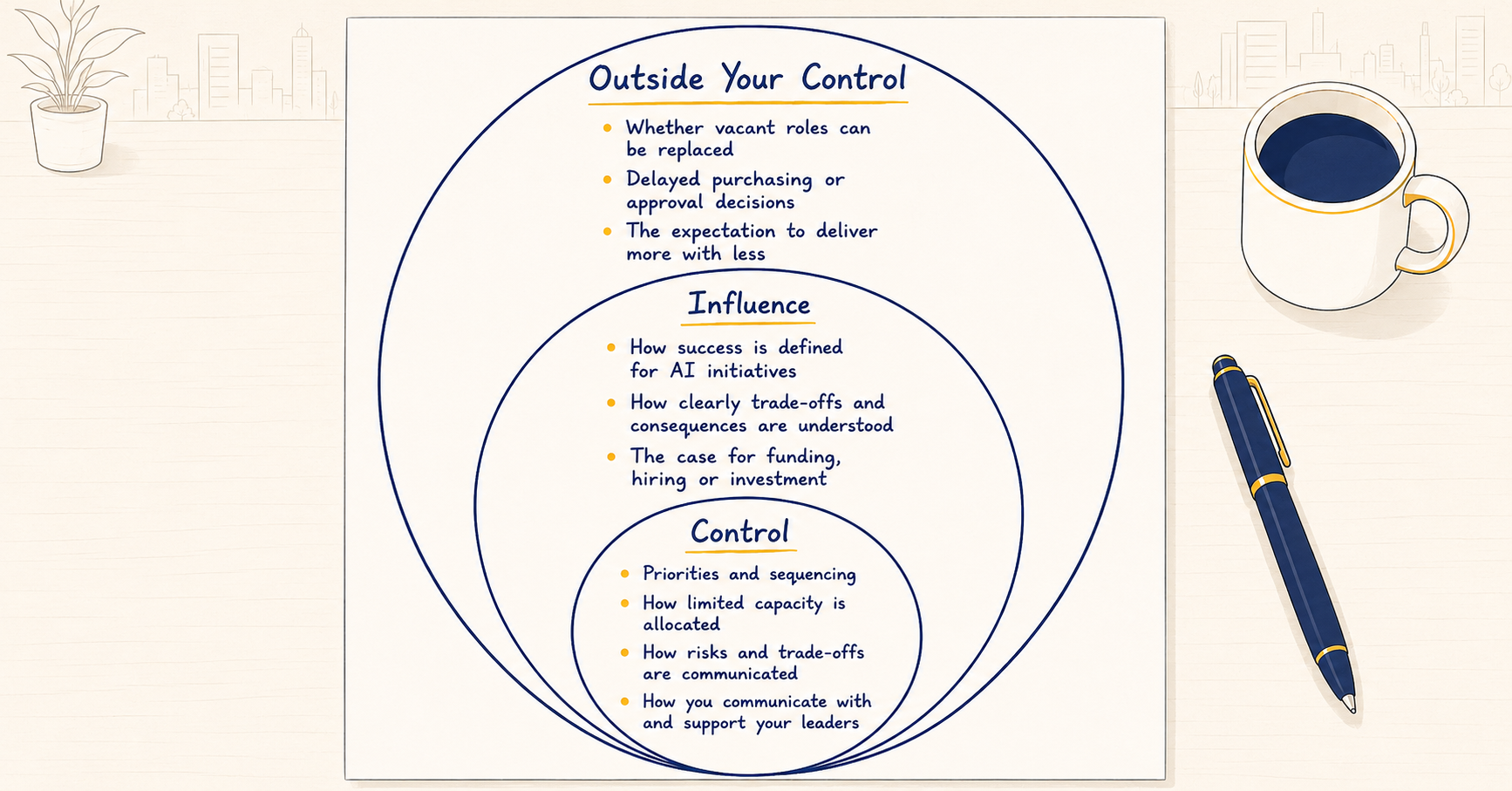
One of the simplest tools I have used in coaching is to ask a leader to put everything on paper and sort it into three areas: what they can control, what they can influence and what sits outside their control.
The categories are straightforward. The discipline of using them is often more challenging.
Getting it out of your head
I worked with a leader whose organization was navigating significant budget uncertainty. Expectations remained high, but approvals were taking longer, open positions could not be replaced and several important technology decisions had been delayed.
At the same time, the leader was under pressure to demonstrate progress from a number of AI initiatives. Some of the work was still early, the measures of success were not yet fully defined and there were different expectations across the senior leadership team about how quickly the investment should produce visible results.
The leader was carrying all of it. At one point they said, “I feel like I am waiting for five decisions I do not own, while my team is looking to me as if I should already have answers.”
That sentence captured the real pressure: not only the uncertainty itself, but the expectation that they should somehow turn uncertainty into certainty for everyone else.
They were also trying to anticipate every possible question from senior stakeholders and every concern from the leaders on their team. The more they thought about the situation, the more everything began to feel connected and equally urgent.
That is an exhausting place from which to lead. It also makes it harder to make clear decisions because the leader is trying to solve problems that sit across several different levels of ownership.
During one of our coaching conversations, we wrote down everything they were carrying. We included the major organizational issues, the decisions that were pending, the concerns they had about their team and the expectations they felt responsible for meeting.
Once everything was on paper, we began sorting it.
What Is Outside Your Control?
We started with the area that can be hardest for leaders to admit, especially when the buck often stops with them: what they could not control.
The final budget decision was not theirs. Neither was approval to replace vacant roles, the pace of purchasing decisions or whether every senior stakeholder would agree on how AI value should be measured.
They also could not control the expectation that the organization should deliver more with fewer resources. That expectation existed whether or not the leader believed it was realistic.
Writing these issues down made the boundary clearer. The leader could recognize that some of the things occupying the most mental space were not theirs to decide.
Acknowledging this helped the leader stop circling around items that were not pending actions or decisions waiting to be completed.
What Can You Influence?
The next area was what the leader could influence.
They could not make the final budget decision, but they could provide clearer information about the impact of different funding scenarios. They could show what work would continue, what would slow down and what would need to stop if resources were reduced.
AI work can be especially difficult to lead because organizations often want certainty from initiatives that are still experimental. The leader could not guarantee that every initiative would meet every expectation, but they could influence how success was defined: which projects were intended to reduce cost, improve productivity, strengthen customer experience or build longer-term organizational capability.
They could also push for more realistic measures and timelines rather than allowing every initiative to be assessed through a vague expectation of immediate return.
The leader could not control whether an open role would be approved, but they could explain the consequences of leaving it vacant. They could make the trade-offs visible and help senior stakeholders understand what the team could realistically deliver without that capacity.
Influence is not the same as control. You can communicate clearly, make a strong case and provide sound recommendations, and the decision may still go another way. You can contribute what you can without assuming ownership of the final outcome.
You are still accountable for results, but you may need to achieve them through relationships, credibility, transparency and the quality of your thinking.
The more important question is not whether you can guarantee the outcome. It is whether you have used your influence clearly and intentionally.
What Can You Control?
The final area was what the leader could directly control.
They could decide how to prioritize the work already underway. They could be more explicit about what the team would continue, what would be delayed and what would stop.
They could define what meaningful progress looked like for the AI initiatives rather than allowing the team to chase unclear or constantly changing expectations. They could ensure that senior stakeholders understood the difference between early experimentation, capability building and measurable business outcomes.
They could also decide how they communicated with the leaders who reported to them. They could be transparent about what was known, what remained uncertain and where decisions were still pending.
They could create space for their leadership team to raise concerns without allowing every concern to become a new priority. They could help their leaders make better decisions about capacity, sequencing and trade-offs.
Most importantly, they could resist the pressure to treat everything as equally important.
When resources are constrained, control often shows up through choices. A leader may not be able to change the budget, but they can decide how to use it. They may not be able to replace headcount, but they can decide which work the team should no longer absorb.
They may not be able to accelerate a delayed buying decision, but they can communicate the impact, adjust the plan and avoid pretending the original timeline is still achievable.
These actions can feel smaller than the larger organizational decisions creating the pressure, but they are not insignificant. They are the decisions through which leadership becomes visible.
The Value of Getting It Out of Your Head
There is a practical reason this exercise works.
When concerns remain in your head, they begin to blur together. A decision you control becomes tangled with a decision you do not. A genuine risk becomes mixed with a possible scenario. Something that requires action sits beside something that requires acceptance.
Putting it on paper creates separation.
It helps you see where you may be investing significant time without changing the outcome. It also helps you identify where you have more agency than you first realized.
For the leader I was coaching, the situation itself did not immediately change. The budget was still uncertain, the hiring decisions were still pending and the AI initiatives were still under scrutiny.
However, they began to respond differently, freeing up mental capacity for what they could control and influence. Their energy moved from private rumination to clearer conversations, sharper trade-offs and more deliberate leadership choices.
A Practical Exercise
When you are facing uncertainty or change, take a sheet of paper and draw three circles: control, influence and outside my control.
Write down everything that is occupying your attention. Include the practical issues, the unanswered questions, the outcomes you are concerned about and the expectations you feel responsible for meeting.
Do not try to organize the list while you are writing it. The first step is simply to get it out of your head.
Then place each item into one of the three areas.
For the items you control, identify the next decision or action you will take. This may involve setting priorities, stopping work, resetting expectations or communicating a trade-off.
For the items you can influence, decide who you need to engage, what you want them to understand and what recommendation you are prepared to make.
For the items outside your control, ask yourself what it would mean to stop treating them as problems you are personally responsible for solving.
You may still need to pay attention to them. You may need to prepare for different outcomes. You may need to communicate the implications.
Acceptance does not mean indifference. It means recognizing the boundary between being aware of something and carrying it.
Where Is Your Leadership Energy Going?
Leaders cannot remove uncertainty for themselves or their teams. They can decide how much of their leadership energy will be spent on outcomes they do not own.
They can use their influence to clarify expectations, make consequences visible and improve the quality of decisions, without confusing influence with ownership.
They can take action where they have real agency: setting priorities, naming trade-offs, communicating honestly and protecting the capacity of their teams.
The discipline is not simply sorting the work. It is refusing to carry ownership for decisions that sit elsewhere while still leading responsibly through them.
Your leadership energy is finite. Spend it where it can create clarity, movement and better decisions, not where it only creates more internal noise.